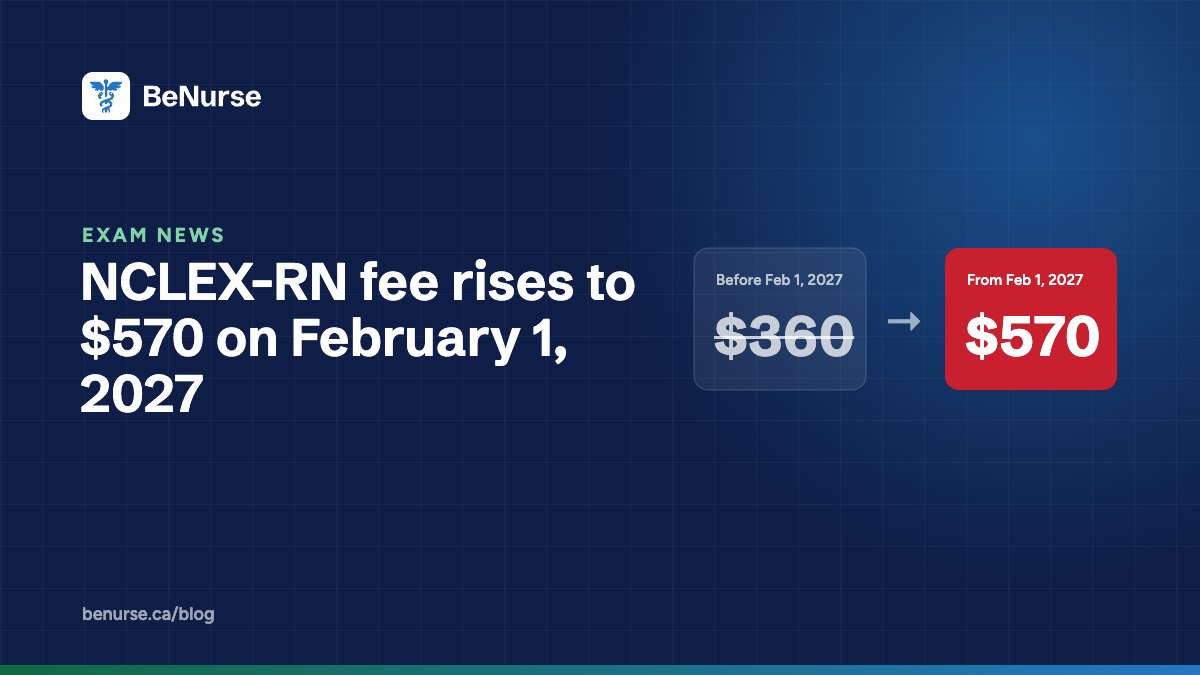
The fee to register for the NCLEX-RN in Canada goes from $360 to $570 for registrations made on or after February 1, 2027. That is a $210 jump, or about 58%, and it is the first change to the registration fee since 2000. If you are a nursing student or an internationally educated nurse heading toward the RN exam, the date that matters is the day you register with Pearson VUE, not the day you sit the exam.
This article sets out what is changing, what is not, what the exam will cost you in total, and how to decide whether registering before February 1 actually saves you money. Every figure links to the organisation that published it.
The change at a glance
| Item | Registrations before Feb 1, 2027 | Registrations on or after Feb 1, 2027 |
|---|---|---|
| NCLEX-RN registration fee (Canada) | $360 CAD + local tax | $570 CAD + local tax |
| Same fee in Ontario, with 13% HST | $406.80 | $644.10 |
| Retake registration | $360 CAD + tax | $570 CAD + tax |
| International scheduling fee (testing outside Canada, US or Australia) | $150 CAD | $150 CAD (unchanged) |
| Change of regulatory body or exam language after registering | $50 CAD each | $50 CAD each (unchanged) |
| REx-PN (RPN and LPN exam in Ontario and BC) | $350 CAD + tax | Not affected |
Sources: NCSBN fee announcement, NCLEX fees and payment, and the College of Nurses of Ontario fee schedule, which lists the NCLEX-RN at $406.80 including HST. The $644.10 figure is $570 plus Ontario’s 13% HST; the tax added in your province will differ.
What exactly did NCSBN decide?
The National Council of State Boards of Nursing (NCSBN), which owns the NCLEX, announced on August 21, 2026 that its Delegate Assembly had voted at its annual meeting to adjust NCLEX registration fees. The new fees are $350 in the United States and Australia and $570 CAD in Canada, effective February 1, 2027.
Three details in the announcement decide who pays what:
- The registration date sets the fee. Registrations completed before February 1, 2027 are charged the current fee, even if the exam itself happens later. Registrations on or after that date pay the new fee, whatever the exam date.
- It applies to every NCLEX registration, including retakes. A candidate who writes in 2027 and needs a second attempt registers again, and that second registration is charged at $570 if it is made after January 31.
- The REx-PN fee is not changing. The REx-PN is a separate NCSBN exam for practical nurses, and the announcement says it is not affected.
NCSBN’s stated reasons are 25 years of inflation since the last adjustment and the rising cost of running a secure exam, including data protection and cybersecurity.
What it will cost to become an RN in Ontario
The NCLEX is one fee among several. Using the College of Nurses of Ontario’s published fees for graduates of approved Canadian programs, all including HST, the regulatory cost of getting registered changes like this:
| Ontario fee (CNO, incl. HST) | Register before Feb 1, 2027 | Register on or after Feb 1, 2027 |
|---|---|---|
| Initial application | $452.00 | $452.00 |
| NCLEX-RN | $406.80 | $644.10 |
| Jurisprudence exam | $45.20 | $45.20 |
| Initial registration and first-year membership | $455.39 | $455.39 |
| Total | $1,359.39 | $1,596.69 |
CNO’s own fees can change on their own schedule, so confirm them on the CNO fee page before you budget. If you are not in Ontario, your regulator publishes its own list; our registration guides by province link to each one.
Should you register before February 1, 2027?
Registering early locks in $360, but only if you can actually use the registration. The NCLEX rules that make this a real decision rather than an obvious one are in the NCLEX Candidate Bulletin:
- A registration stays open for 365 days. If your regulator has not made you eligible within that window, you forfeit the registration and the fee.
- NCLEX registration fees are not refunded for any reason, including duplicate registrations and missed appointments.
- Once you are made eligible, your Authorization to Test (ATT) is valid for a period your regulator sets, on average 90 days, and it cannot be extended.
So the question is not “can I save $210?” but “will my regulator make me eligible within 365 days of the day I register?”
A quick way to decide
| Your situation | What usually makes sense |
|---|---|
| You have finished, or will finish, your program early enough that your regulator can confirm eligibility well within a year of registering | Register before February 1, 2027 to pay $360. Apply to your regulator at the same time so the clock is not wasted. |
| You graduate later in 2027 or 2028 | Registering now risks losing $360 if you are not eligible within 365 days, and then paying $570 anyway. Check your expected eligibility date with your regulator before deciding. |
| You are an internationally educated nurse still in credential assessment | The assessment route through NNAS and your regulator often takes longer than a year. Register only once your regulator expects to make you eligible within the 365-day window. |
| You are booked to write soon and want a safety net for a retake | You cannot pre-buy a retake. A second registration is a new registration, charged at $570 after January 31, 2027. |
Order of steps. The bulletin’s sequence is: apply to your regulator, register with Pearson VUE, wait for the regulator to make you eligible, receive your ATT, then book. Some regulators word this differently. The Registered Nurses Association of the Northwest Territories and Nunavut, for example, counts the 365 days from when it is notified of your Pearson VUE registration. Follow your own regulator’s instructions.
Retakes now cost more, so first-attempt preparation matters more
NCSBN allows up to eight NCLEX attempts a year with at least 45 test-free days between them, although some regulators allow fewer. From February 2027, each retake adds $570 plus tax to the bill, on top of the weeks of waiting. The cheapest attempt is the one you only take once.
Two things move a first-attempt result more than anything else:
- Practising the question formats you will actually see. The NCLEX-RN gives partial credit on many items, and how you answer under each scoring rule changes your score. Our guide to the ten NCLEX item formats and how each is scored covers this.
- Finding your weak clinical judgment step early. The exam is built on six steps, from recognizing cues to evaluating outcomes. A candidate who is strong at the first and weak at “take action” needs a different study plan from one who is the reverse. The free readiness diagnostic shows you which step is costing you points.
How nursing organisations have reacted
The Canadian Federation of Nurses Unions and the Canadian Nursing Students’ Association publicly opposed the increase on August 25, 2026. CFNU President Linda Silas said that “now is not the time to increase the financial burden on nursing students.” The groups have asked NCSBN to reconsider and asked governments to fund paid preceptorships, bursaries and student loan forgiveness. Their release cites Statistics Canada’s count of 26,180 nursing vacancies in the first quarter of 2026 (CFNU release).
As of this writing the fee change is still scheduled for February 1, 2027. If NCSBN revises it, we will update this article.
Does this affect the REx-PN or the CPNRE?
- REx-PN (RPNs in Ontario and LPNs in British Columbia): NCSBN says the REx-PN fee is not affected. CNO lists it at $350 plus tax ($395.50 with HST). See our REx-PN overview.
- CPNRE (LPNs in the other provinces and territories): a different exam, with fees set by each regulator. In Alberta, for example, the College of Licensed Practical Nurses lists an all-inclusive fee of $610 ($495 exam plus $115 administration) on its CPNRE page. See our CPNRE overview.
Not sure which exam applies to you? Two questions settle it: your designation and your province.
Frequently asked questions
If I register in January 2027 and write in March 2027, which fee do I pay?
$360 plus tax. The registration date decides the fee, not the exam date.
If I register before February 1 and fail, is my retake also $360?
No. A retake is a new registration. If you register for it on or after February 1, 2027, it costs $570 plus tax.
Can I get a refund if I registered early and my eligibility is delayed past 365 days?
No. NCSBN states that registration fees are not refunded for any reason, and an expired registration forfeits the fee.
Is the $570 fee in Canadian dollars?
Yes. NCSBN lists the Canadian fee as $570 CAD. Pearson VUE adds local taxes on top.
This article reflects NCSBN, NCLEX and regulator publications available on November 9, 2026. Fees and policies change; always confirm with NCLEX.com and your nursing regulator before you pay.