On the NCLEX-RN, a question can be worth more than one point, and you can earn some of those points without getting everything right. On some questions a wrong choice also costs you a point. Knowing which rule applies changes how you should answer when you are unsure, and that is a skill most candidates never practise deliberately.
The REx-PN, the exam for RPNs in Ontario and LPNs in British Columbia, works differently. This article explains both, using NCSBN’s own documents, so you can practise the right habits for the exam you are actually writing.
The short version
| NCLEX-RN (Canada) | REx-PN (Ontario and BC) | |
|---|---|---|
| Partial credit | Yes, on any item with more than one correct answer | Only on multiple-response (“select all that apply”) items, since January 2026 |
| Scoring rules | Three: plus/minus, zero/one, rationale | Correct or incorrect, plus partial credit on multiple response |
| Clinical judgment case studies | Three case studies of six items each (18 items) | Not listed in the REx-PN test plans |
| Item formats named in the test plan | “Multiple item formats”, stand-alone items and case studies | Multiple choice, multiple response, fill-in-the-blank calculation, exhibit, graphics |
| Length | 85 to 150 items, 15 unscored | 90 to 150 items, 30 unscored |
| Time limit | 5 hours, including breaks | 4 hours, including breaks |
Sources: 2026 NCLEX-RN Test Plan, NCLEX FAQs, current REx-PN Test Plan and the REx-PN Test Plan effective January 2027.
Why the NCLEX-RN gives partial credit at all
Since the Next Generation NCLEX launched in April 2023, many items ask you to make several decisions at once: which findings matter, which actions are indicated, which hypotheses fit. Scoring the whole item as simply right or wrong would throw away most of that information. Partial credit lets the exam measure how much of the clinical reasoning you got right, which is why NCSBN describes it as more precise measurement.
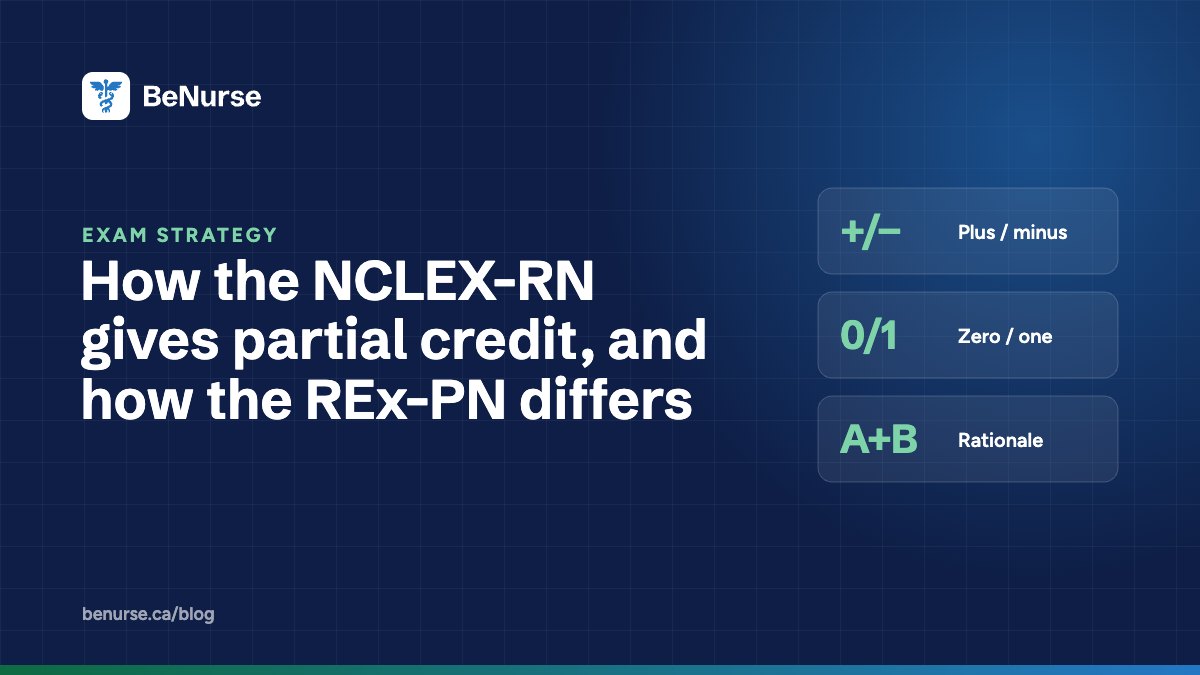
The 2026 test plan puts it in one line: there is partial credit scoring for items for which more than one key exists, and there are three methods for doing it.
The three NCLEX-RN scoring rules, with worked examples
NCSBN does not publish a table that maps every item format to a scoring rule. What it does publish, in the NCLEX FAQs, is the condition that triggers each rule. That is the more useful thing to know, because you can recognise the condition on screen.
1. Plus/minus: when the item does not tell you how many to choose
The trigger: “Select all that apply” with no number given. The rule: each correct choice earns a point and each incorrect choice loses a point. The item cannot go below zero, and the maximum equals the number of correct options.
Example. A question lists six actions, and three are correct.
| What you selected | Calculation | Score |
|---|---|---|
| All three correct actions | 3 − 0 | 3 of 3 |
| Two correct actions | 2 − 0 | 2 of 3 |
| Two correct and one incorrect | 2 − 1 | 1 of 3 |
| Three correct and two incorrect | 3 − 2 | 1 of 3 |
| One correct and three incorrect | 1 − 3, floored | 0 of 3 |
What this means for you: selecting everything is not a safe strategy. A choice you are genuinely unsure about is worth thinking through on its own merits, because a wrong selection undoes a right one. Choose an option because you can say why it is indicated for this client, not because it is generally good nursing.
2. Zero/one: when the item tells you how many to choose
The trigger: the item tells you how many responses to give. That includes “select the 3 findings that require follow-up”, and, by the same logic, grids and drop-downs where each row or blank takes exactly one answer. The rule: each correct response earns a point and an incorrect response earns nothing. Nothing is subtracted.
Example. A matrix asks you to mark each of five orders as indicated or contraindicated. You are confident about four rows and unsure about one.
- Leave the fifth row blank: at most 4 of 5.
- Answer the fifth row with your best judgment: 4 of 5 if wrong, 5 of 5 if right.
What this means for you: never leave a row, blank or required selection empty on a zero/one item. A blank scores the same as a wrong answer, and an answer has a chance of being right.
3. Rationale: when two pieces only make sense together
The trigger: the item pairs linked ideas, typically a cause and its effect (“The client is at risk for ___ as evidenced by ___”). The rule: both parts of the pair must be correct to earn the point. One right half earns nothing.
Example. “The nurse should first address the client’s [condition] because of the client’s [finding].” Choosing the right condition with a finding that does not support it scores zero for that pair.
What this means for you: answer these as a single thought. Pick the finding first if it helps, then check that your condition is the one that finding actually points to.
Where the bow-tie and case studies fit
Every NCLEX-RN includes three clinical judgment case studies. Each one is six items about the same client, and each item targets one step of NCSBN’s Clinical Judgment Measurement Model: recognize cues, analyze cues, prioritize hypotheses, generate solutions, take action and evaluate outcomes. About 10% of the exam is also stand-alone items (2026 RN Test Plan). NCSBN’s own Next Generation materials show the bow-tie and trend formats among the clinical judgment stand-alone items (NCSBN presentation, 2021).
Each case study item uses one of the three rules above, so the same habits apply inside a case: count before you click on unlimited selections, fill every row on a grid, and treat paired drop-downs as one decision. If you want to see how the six steps differ, our explainer on the clinical judgment model walks through each one, and our unfolding case studies let you practise all six in order.
How the REx-PN is different
The REx-PN is also an NCSBN exam and also adaptive, so it is easy to assume it mirrors the NCLEX-RN. Its test plans say otherwise.
- Formats. The current plan and the plan effective January 2027 both list the same formats: multiple choice, multiple response, fill-in-the-blank calculation, exhibit and graphics. Neither mentions clinical judgment case studies, bow-tie or matrix items.
- Scoring. The current REx-PN test plan states that from January 2026 all items are scored correct or incorrect, except multiple-response “select all that apply” items, which are scored for partial credit. The 2027 plan keeps the same principle: single-key items are right or wrong, and items with more than one key get partial credit.
- What the plans do not say. Neither REx-PN plan says whether a wrong selection on a multiple-response item subtracts a point, as plus/minus does on the NCLEX-RN. Until NCSBN says so, the safe habit is the same one: select an option only when you can justify it for this client.
- Length and timing. 90 to 150 items, 30 of them unscored pretest items, in four hours.
The practical upshot for REx-PN candidates: spend your practice time on clinical reasoning in multiple choice and multiple response, dosage calculation, and reading exhibits such as charts and lab tables, rather than on NCLEX-RN case-study formats. Our REx-PN overview covers the exam’s content areas, and the dosage calculation drills give unlimited fill-in-the-blank practice.
Five habits that follow from the rules
- Read the instruction line before the options. “Select all that apply” with no number means plus/minus on the NCLEX-RN. A number means zero/one.
- On unlimited selections, judge each option alone. Ask “is this indicated for this client right now?” for every option, independently of the others.
- On grids and drop-downs, never leave a blank. An unanswered row cannot score.
- Treat linked drop-downs as one answer. Half a pair is worth nothing under rationale scoring.
- Do not chase a guessed total. There is no rule that a question has “usually three” correct answers. Trust the client data, not a pattern.
The fastest way to build these habits is to practise under the same rules. Our NCLEX-RN practice sets score every item with plus/minus, zero/one or rationale scoring and show you the points item by item, and the guide to all ten item formats shows which rule each of our formats uses. To find the clinical judgment step that is costing you the most, start with the free readiness diagnostic.
Frequently asked questions
Can a single NCLEX-RN item give me a negative score?
No. NCSBN states that under plus/minus scoring the minimum score is zero.
Does partial credit change how the NCLEX-RN decides pass or fail?
The exam is still computerized adaptive: it keeps estimating your ability as you answer and stops when it is confident you are above or below the passing standard, or when you reach the maximum length or run out of time. Partial credit feeds that estimate with more detail from each item. NCSBN’s FAQs do not publish more than that, so be wary of any source claiming an exact formula.
Is the REx-PN going to add case studies?
The REx-PN test plan effective January 2027 does not list them. If NCSBN announces a change, it will appear on REx-PN.com first.
Which exam do I write?
It depends on your designation and province. Outside Quebec, which runs its own exams, RNs write the NCLEX-RN, RPNs in Ontario and LPNs in British Columbia write the REx-PN, and LPNs in the other provinces and territories write the CPNRE. Our exam finder confirms it in two questions.
Based on NCSBN publications available on November 9, 2026: the 2026 NCLEX-RN Test Plan, the NCLEX FAQs and the REx-PN Test Plans effective 2022 and January 2027. If NCSBN changes its scoring, we will update this article.