

Francophone nursing graduates outside Quebec can write the NCLEX-RN in French. The option has existed since the exam replaced the CRNE in Canada in January 2015, yet the practical details are scattered across NCSBN’s FAQ, the French candidate bulletin, a fee schedule and provincial regulator pages. This post pulls them together: what the French exam is, what it costs, which official French materials exist, how Quebec fits in, and the questions NCSBN does not answer publicly.
The short version
| NCLEX-RN in French | NCLEX-RN in English | |
|---|---|---|
| Who it is for | French-speaking candidates registering in Canada | All candidates in Canada and the United States |
| Exam content | The same exam, translated into Canadian French | The source version |
| Length | 85 to 150 items | 85 to 150 items |
| Time limit | Five hours, breaks included | Five hours, breaks included |
| Test plan in force | 2026 test plan, April 1, 2026 to March 31, 2029 | Same |
| Registration fee in Canada | $360 CAD, rising to $570 CAD for registrations from February 1, 2027 | Same |
| Changing language after registering | $50 CAD | $50 CAD |
Sources: NCLEX FAQs, NCLEX fees and payment, the 2026 French candidate bulletin and the 2026 French RN test plan.
Is the French exam really the same test?
Yes. NCSBN states that the same NCLEX-RN is used for entry to practice in Canada and the United States, and that it offers the exam in French to meet the needs of French-speaking Canadian candidates. The French version is not a separate exam with its own content outline. It is a translation of NCSBN’s operational item pools: according to the FAQ, NCSBN translates two operational pools into French each year, and the French pool is administered to French Canadian NCLEX-RN candidates.
NCSBN’s document on translating the NCLEX describes the process: a vendor translates approved items from English into Canadian French, and the translations are then reviewed by a panel of bilingual Canadian nurses. The College of Registered Nurses of Manitoba’s NCLEX FAQ adds that all items appearing on an English version of the exam in a given period have been translated into French.
What this means for preparation:
- Same structure. The French test plan sets the same 85 to 150 items and five-hour limit, breaks included. The shortest exam includes three case studies of clinical judgment items, just as in English. Our clinical judgment guide and case studies apply in either language.
- Same item types. Matrix, drag-and-drop, highlight, bow-tie and the rest are formats, not language features. See every NCLEX item type.
- Same stopping rules and scoring. Computerized adaptive testing, the stopping rules and partial credit work identically. We explain them in how the NCLEX-RN decides when to stop and NCLEX-RN partial credit scoring explained.
What it costs, and the date that matters
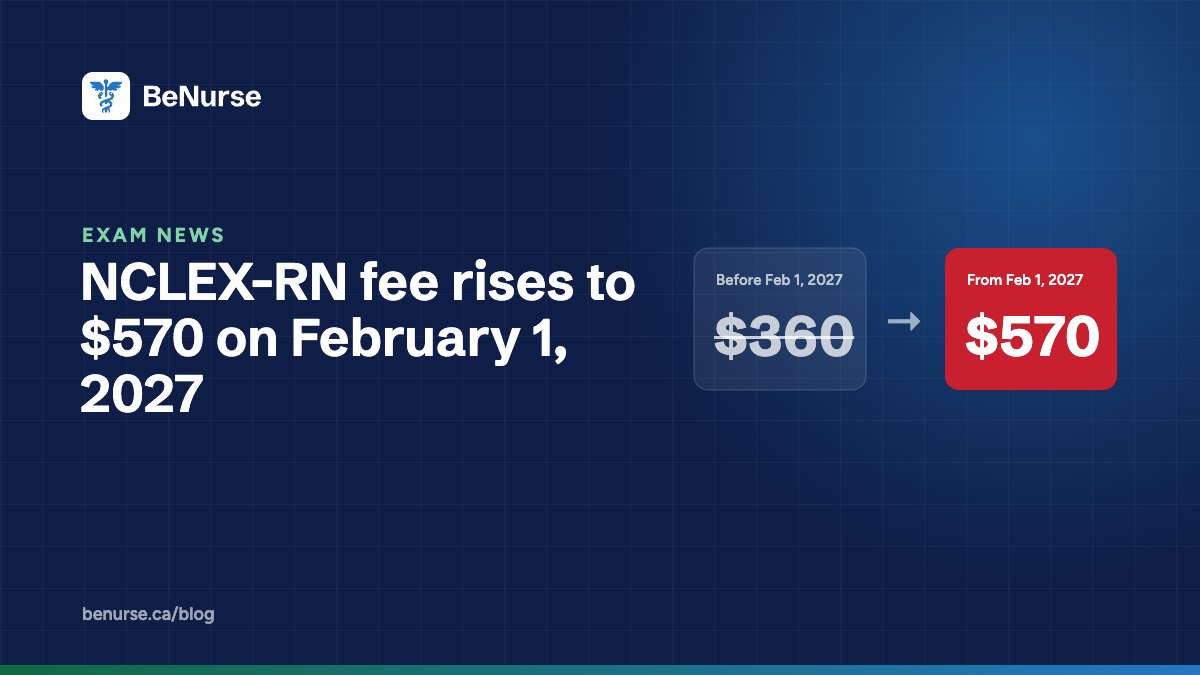
The NCLEX registration fee for Canadian candidates is currently $360 CAD, excluding local taxes. NCSBN has announced that in Canada the fee will be $570 CAD from February 1, 2027, and that registrations completed before that date are charged the current fee. The rule is the same in both languages. If you are a French-speaking graduate planning to write in early 2027, registering before February 1 saves $210. We covered the increase in detail in NCLEX-RN fee rises to $570 on February 1, 2027.
$50 CAD is the fee NCSBN lists for changing your exam language (English or French) after registration. The fee applies to Canadian candidates only. Choosing correctly the first time avoids it.
Other Canadian fees on the same schedule: $50 CAD to change your nursing regulatory body after registering, and $150 CAD extra to test at an international location. Note also that, according to the candidate bulletin, the paid Quick Results service is not available to candidates seeking registration in Canada, so you will get your official result from your regulator.
Official French-language materials
NCSBN lists the following reference materials as available in French in its FAQ (question “What reference materials are available in French?”):
- The NCLEX-RN test plans, including the 2026 French test plan
- The NCLEX tutorial, linked as “Regardez le Tutoriel” from the NCLEX preparation page
- The candidate bulletin
- The NCLEX webinar series
- The NCLEX exam preview
- The NCLEX FAQs
The French bulletin also notes that candidates who want to read the candidate rules in French can ask the test administrator for them. For phone support in French, Pearson VUE lists a Canadian French line on its NCLEX contact page: 1-866-288-8454.
Where Quebec fits
The Canadian Council of Registered Nurse Regulators states that anyone applying to practise as a registered nurse in Canada must pass the NCLEX-RN, with the exception of Quebec. Quebec’s order of nurses, the OIIQ, runs its own professional exam. The French NCLEX-RN is therefore aimed at francophone graduates registering in the other provinces and territories, for example in New Brunswick, Ontario or Manitoba.
Two provincial rules are useful to know if you studied in Quebec or are near the border:
- New Brunswick. The province’s nursing regulator states on its exam page that candidates must pass the NCLEX-RN or the OIIQ professional exam within three years, and that graduates of Quebec schools of nursing and OIIQ applicants are not eligible to write the NCLEX. Its information sheet adds that New Brunswick graduates, French or English speaking, may choose the OIIQ exam instead.
- Ontario. The College of Nurses of Ontario’s RN examinations page says its Council approved the OIIQ professional examination, passed within three attempts, as meeting the exam requirement.
Rules in other provinces for Quebec graduates vary, so confirm with the regulator where you plan to register. Our registration pathway and Ontario pathway pages show where the exam sits among the other requirements.
What NCSBN does not publish
Three questions French-speaking candidates ask often have no public answer in NCSBN’s or Pearson VUE’s materials as of our check:
- Exactly how to select French when registering. The bulletin confirms a fee to change language after registration but does not walk through the selection step. Confirm your language choice with Pearson VUE’s French line before you pay, rather than discovering it on exam day.
- Which test centres deliver the French version. NCSBN says the NCLEX can be taken year-round at Pearson Professional Testing locations, and New Brunswick’s regulator lets candidates write at any Pearson VUE centre. Neither source lists French availability by centre, so ask when booking.
- French pass rates. NCSBN’s 2025 exam statistics report Canadian results (86.0% of 10,789 first-time, Canadian-educated candidates passed) but do not break them down by language. For the full provincial picture, see NCLEX-RN pass rates in Canada for 2025.
Before you register: a checklist for francophone candidates
☐ Confirm with your regulator that you are eligible for the NCLEX-RN (Quebec graduates may be directed to the OIIQ exam instead)
☐ Download the 2026 French test plan and the French candidate bulletin
☐ Work through the French tutorial so the item formats are familiar in the language you will test in
☐ Call Pearson VUE’s French line (1-866-288-8454) to confirm how your French selection is recorded and that your chosen centre offers it
☐ Register before February 1, 2027 if you want the $360 CAD fee
☐ Practise under exam conditions with our NCLEX-RN practice questions and a full timed simulation
Learning clinical vocabulary in both languages helps in a bilingual workplace, but on exam day the goal is narrower: to read every item in the language you chose without second-guessing. If you studied in English and work in French, or the reverse, try a few practice sets in each before deciding. Start with our free diagnostic and the NCLEX-RN overview.
Checked against NCSBN (NCLEX FAQs in English and French, fees and payment page, 2026 English and French candidate bulletins, 2026 French RN test plan, Translating the NCLEX, 2025 NCLEX exam statistics), Pearson VUE’s NCLEX contact page, the Canadian Council of Registered Nurse Regulators, the College of Nurses of Ontario, New Brunswick’s nursing regulator and the College of Registered Nurses of Manitoba on November 16, 2026. BeNurse is not affiliated with NCSBN, Pearson VUE, the OIIQ or any nursing regulator.