
NCSBN published its full-year NCLEX statistics for 2025 in June 2026, and the Canadian numbers moved the wrong way almost everywhere. Canadian-educated nurses writing the NCLEX-RN for the first time still passed at a high rate, but lower than in 2024. Internationally educated nurses fell much further.
Below are the figures from NCSBN’s own reports, set side by side with 2024, with a plain reading of what they do and do not tell you.
86.0% of first-time, Canadian-educated candidates passed the NCLEX-RN in 2025, down from 87.8% in 2024. Across every candidate who wrote for Canadian registration, first attempts and retakes combined, the pass rate fell from 67.5% to 58.9%.
Source for every figure in this article: NCSBN, 2025 NCLEX Examination Statistics (Research Brief Vol. 96, June 2026) and 2024 NCLEX Examination Statistics. “Canada-educated” means the nursing program was completed in Canada. “Internationally educated” means it was completed elsewhere. All figures are for candidates writing for Canadian registration, not US licensure.
Every candidate group, 2024 against 2025
| Candidate group | Wrote in 2025 | Passed in 2025 | 2025 pass rate | 2024 pass rate |
|---|---|---|---|---|
| First attempt, educated in Canada | 10,789 | 9,282 | 86.0% | 87.8% |
| Retake, educated in Canada | 2,396 | 1,452 | 60.6% | 62.8% |
| First attempt, educated outside Canada | 7,312 | 2,893 | 39.6% | 49.8% |
| Retake, educated outside Canada | 5,982 | 1,959 | 32.7% | 43.1% |
| All candidates | 26,479 | 15,586 | 58.9% | 67.5% |
Two things stand out. The Canadian-educated drop is real but modest, about two points on each line. The internationally educated drop is about ten points on each line, and the number of internationally educated retakes rose from 3,665 to 5,982 in a single year. That second story is big enough that we gave it its own article: internationally educated nurses and the NCLEX-RN in 2025.
For comparison, first-time US-educated candidates writing for US licensure passed at 86.7% in 2025, almost the same as their Canadian-educated counterparts.
Province by province
NCSBN breaks out first-time, Canadian-educated candidates by the regulator they wrote for. Every province or territory except Saskatchewan was lower in 2025 than in 2024, and Saskatchewan was flat.
| Regulator | Wrote (2025) | 2025 | 2024 | Change |
|---|---|---|---|---|
| Newfoundland and Labrador | 245 | 92.2% | 94.1% | −1.9 |
| Alberta | 1,511 | 91.3% | 92.0% | −0.7 |
| Manitoba | 644 | 90.5% | 93.5% | −3.0 |
| British Columbia | 1,620 | 89.7% | 93.7% | −4.0 |
| Ontario | 5,152 | 84.3% | 88.0% | −3.7 |
| Nova Scotia | 434 | 84.1% | 88.8% | −4.7 |
| Prince Edward Island | 80 | 83.8% | 91.7% | −7.9 |
| New Brunswick | 339 | 82.6% | 82.7% | −0.1 |
| Saskatchewan | 683 | 76.9% | 76.9% | 0.0 |
| Northwest Territories and Nunavut | 26 | 76.9% | 85.0% | −8.1 |
| All ten regulators | 10,734 | 86.1% | 88.8% | −2.7 |
Change is in percentage points. NCSBN’s provincial total (10,734) is 55 lower than its national first-attempt figure (10,789), because a small number of candidates were educated in jurisdictions outside the ten regulators that use the NCLEX-RN. Quebec does not use the NCLEX-RN; the Ordre des infirmières et infirmiers du Québec runs its own exam.
Ontario matters most for the national figure. Almost half of all first-time Canadian-educated candidates wrote for the College of Nurses of Ontario, so its 3.7-point drop pulls the national number down more than any other province. If you are studying in Ontario, our Ontario registration guide sets out the full sequence from graduation to registration.
When in the year people wrote, and how they did
| Quarter of 2025 | First attempt, Canadian-educated | Pass rate | All candidates | Pass rate |
|---|---|---|---|---|
| January to March | 1,850 | 86.5% | 5,292 | 57.3% |
| April to June | 4,000 | 88.1% | 7,465 | 66.1% |
| July to September | 3,422 | 84.0% | 7,858 | 59.0% |
| October to December | 1,517 | 84.6% | 5,864 | 50.8% |
Spring is when most Canadian programs finish, and the April to June quarter had both the most first-time Canadian-educated candidates and their best results. The fourth quarter was the weakest for the all-candidates figure, at 50.8%, which reflects how many of that quarter’s candidates were retakes or internationally educated.
Five cautions before you read too much into this
- The exam’s difficulty did not change. NCSBN’s passing standard for the NCLEX-RN is 0.00 logits. Its Board kept that standard at its December 2022 review, and it is set to stay there through March 31, 2029. A lower pass rate is not evidence of a harder pass mark.
- The test plan changed slightly on April 1, 2026, not in 2025. NCSBN describes the 2026 RN test plan as keeping the same format and category weights, with minor edits. It cannot explain 2025 results.
- Small groups swing. Prince Edward Island had 80 first-time candidates and the Northwest Territories and Nunavut had 26. A handful of people account for several percentage points there.
- NCSBN reports outcomes, not causes. The report does not say why rates fell, and any article that tells you exactly why is guessing.
- A program’s own pass rate is a separate number. The figures above are by regulator. Your school’s result can sit well above or below its province’s average; regulators and schools publish those separately.
What this means for a first-time candidate
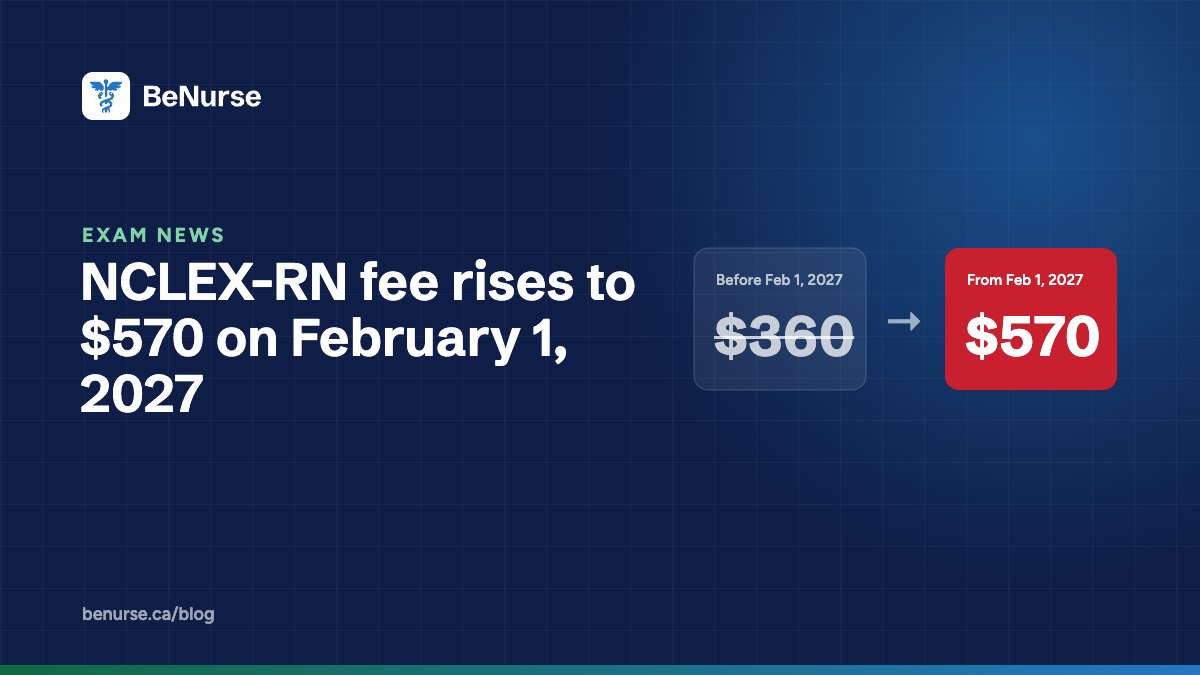
Roughly six in seven Canadian-educated nurses pass on their first attempt. That is good news, but it also means about 1,500 people who trained in Canada did not pass first time in 2025, and their retake pass rate was 60.6%. From February 1, 2027, each new registration also costs $570 plus tax instead of $360. Both are reasons to treat the first attempt as the one that counts.
A practical checklist, drawn from how the exam is actually built:
- ☐ Find your weakest clinical judgment step. The NCLEX-RN measures six of them, from recognizing cues to evaluating outcomes. The free readiness diagnostic shows which one is costing you points.
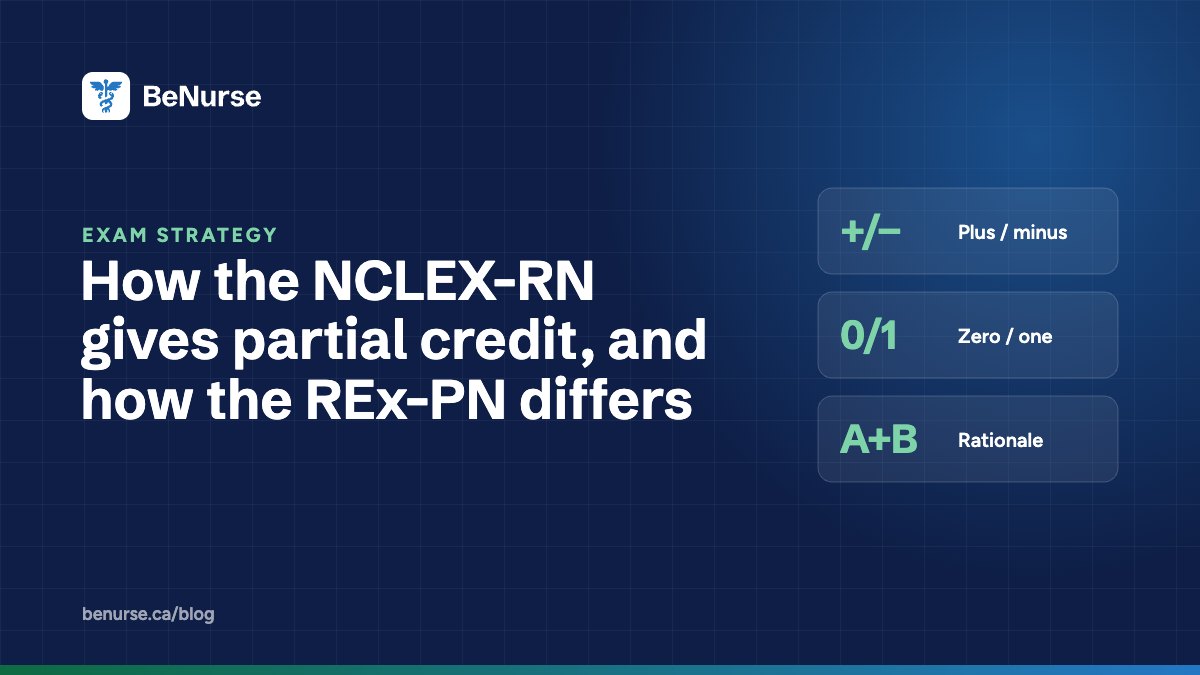
- ☐ Practise every item format under its real scoring rule. Several formats give partial credit and some subtract for wrong choices. Our explainer on how partial credit works covers the three rules, and the item format guide lets you try each one.
- ☐ Work through whole case studies, not only single questions. Every NCLEX-RN includes three six-item case studies. Our unfolding case studies follow one client across all six steps.
- ☐ Sit at least one full-length simulation. The exam can run up to five hours. The NCLEX-RN simulation builds stamina as well as knowledge.
- ☐ Book while your knowledge is fresh. The spring cohort had the best results in 2025. If you graduate in spring, aim to write soon after your regulator makes you eligible.
Questions we get about these numbers
Is the NCLEX-RN harder to pass in Ontario than in Alberta?
No. Every candidate writes the same exam against the same passing standard. The difference in pass rates comes from who writes in each province, not from the exam itself.
Where can I check my school’s pass rate?
Your provincial regulator or your nursing program is the place to ask. NCSBN’s national report stops at the regulator level.
When will the 2026 figures be out?
NCSBN has published each year’s full statistics in the following spring or summer; the 2025 report came out in June 2026. We will update this article with the 2026 numbers when they are released.
Figures checked against NCSBN’s 2025 and 2024 NCLEX Examination Statistics on November 10, 2026. BeNurse is not affiliated with NCSBN.