
In 2025, 7,312 nurses educated outside Canada wrote the NCLEX-RN for the first time to register here. Fewer than four in ten passed. A year earlier it was about half.
If you are an internationally educated nurse (IEN) working toward Canadian registration, that number is worth understanding before you book, not after. This article sets out NCSBN’s figures, the Ontario rule change that affects many IENs this year, and a study plan built around the numbers.
The figures
All numbers below come from NCSBN’s 2025 NCLEX Examination Statistics (June 2026) and the 2024 edition, for candidates writing for Canadian registration.
- First attempt: 39.6% passed in 2025 (2,893 of 7,312), down from 49.8% in 2024.
- Retakes: 32.7% passed in 2025 (1,959 of 5,982), down from 43.1%.
- Volume of retakes: up from 3,665 to 5,982 in one year, a rise of about 63%.
- Canadian-educated first attempts, for contrast: 86.0%. Our province-by-province breakdown has the full picture.
- The same exam for US licensure: internationally educated candidates writing for a US board passed at 47.3% on their first attempt in 2025.
By country of nursing education
NCSBN reports first-attempt results by the country where the candidate trained. These are the countries with the most candidates writing for Canadian registration:
| Country of education | First attempts, 2025 | Pass rate 2025 | Pass rate 2024 |
|---|---|---|---|
| India | 4,559 | 31.6% | 41.2% |
| Philippines | 966 | 47.7% | 55.7% |
| Nigeria | 646 | 54.0% | 54.0% |
| United Kingdom | 135 | 51.9% | 58.4% |
| Ghana | 122 | 44.3% | 49.3% |
| Hong Kong | 81 | 76.5% | 89.5% |
| Nepal | 74 | 55.4% | 60.0% |
| Australia | 55 | 69.1% | 74.2% |
| Brazil | 55 | 65.5% | 64.0% |
| Pakistan | 43 | 60.5% | 58.8% |
Brazil and Pakistan were the only countries in this list to improve, and with 55 and 43 candidates, small groups move easily. India-educated nurses made up 62% of all internationally educated first attempts in 2025, so the drop in their pass rate, almost ten points, drives most of the overall fall. The number of India-educated first attempts also grew, from 3,812 to 4,559, while Philippines-educated first attempts roughly halved, from 1,893 to 966.
Why is the gap so wide?
NCSBN publishes outcomes, not explanations, so treat anything that claims to know the single cause with suspicion. What we can point to is how the exam is designed, and where that design catches nurses trained under a different system:
- The NCLEX-RN tests judgment, not recall. Since 2023 the exam is built on NCSBN’s Clinical Judgment Measurement Model. Many items ask what this client needs first, rather than testing a fact. Nurses trained in programs that assess mainly through recall can know the content and still miss the item. Our clinical judgment explainer walks through the six steps.
- Scope of practice differs. The exam assumes a North American RN’s scope: what an RN may do independently, what to delegate, and when to call the prescriber. Questions on delegation and prioritization reward that specific model.
- Partial-credit items punish over-selecting. On “select all that apply” items with no number given, each wrong choice cancels a right one. Habits from exams that reward choosing everything plausible cost points here. See how NCLEX-RN partial credit works.
- Units and reference ranges. Canadian charts report labs in SI units, such as glucose in mmol/L and haemoglobin in g/L, while many study resources use US units. Our lab values reference lists both, with the conversion factor between them.
- Time since graduation. Many IENs write years after finishing school, often while working in another role. That is not a failing, but it means relearning exam-style reasoning, not only content.
The Ontario change that affects IENs in 2026
Writing the NCLEX-RN is only one requirement. In Ontario, the College of Nurses of Ontario (CNO) also requires evidence of practice: proof of nursing practice or completed nursing education within the past three years.
Since January 12, 2026, CNO accepts only paid nursing practice for this requirement. Volunteer or unpaid nursing no longer counts for new applicants. People who applied before that date had until April 27, 2026 to submit volunteer practice. (CNO evidence of practice FAQ)
If you have not had a paid nursing role in the last three years, CNO lists other routes, including:
- the Supervised Practice Experience Partnership (SPEP), a period of supervised practice in Ontario;
- an approved IEN education pathway, or additional nursing education with theory and clinical parts;
- for RN applicants, a score of 3.50 or higher on the Objective Structured Clinical Examination in the RNCCAP assessment, completed within three years.
The requirement is described in full on CNO’s evidence of practice page. The change was reported by the Registered Nurses’ Association of Ontario’s journal, including concerns from IEN advocates that the rule is hard to meet.
The order of steps in Ontario
Every regulator sets its own process, and the steps below are Ontario’s. For other provinces, start from our internationally educated nurse guide and the registration guides by province.
- Have your credentials assessed through NNAS. CNO calls the National Nursing Assessment Service the first step for nurses educated outside Canada, and states it will not consider you an applicant until NNAS is complete (CNO on NNAS).
- Apply to CNO and follow its instructions on education, language proficiency and evidence of practice.
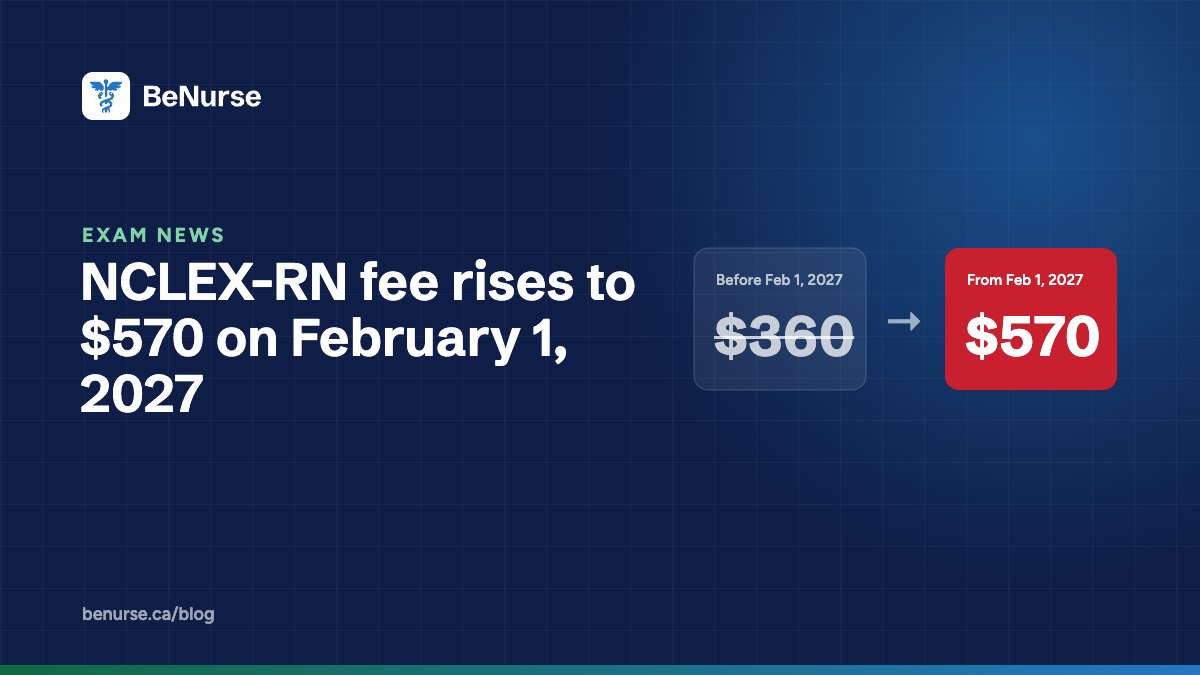
- Register for the NCLEX-RN with Pearson VUE when CNO tells you to. Registrations made from February 1, 2027 cost $570 plus tax instead of $360, and a registration expires if you are not made eligible within 365 days.
- Write the exam once you receive your Authorization to Test.
- Complete the remaining CNO requirements, including the jurisprudence exam, and register.
A study plan built around the numbers
With a first-attempt pass rate under 40% and a retake rate under 33%, the plan has one goal: pass the first time. This is how we suggest structuring it.
| Phase | What to do | Use on BeNurse |
|---|---|---|
| Week 1: baseline | Measure where you lose points before you study anything. Note which clinical judgment step is weakest. | Readiness diagnostic |
| Weeks 2 to 5: the model | Learn how each item format is scored and practise the formats that are new to you, especially matrix, drop-down and highlight items. | Item format guide, practice sets |
| Weeks 3 to 8: content by weakness | Work the client-needs categories where your diagnostic scores were lowest. Read every rationale, including on questions you got right. | Practice by category |
| Weeks 5 to 9: whole cases | Practise case studies in order, all six steps for one client, to build the reasoning chain the exam rewards. | Unfolding case studies |
| Weeks 9 to 10: full length | Sit at least two full-length simulations under time. Review every item you changed your answer on. | NCLEX-RN simulation |
Ten weeks suits someone studying alongside a job. Adjust the length, not the order: the baseline comes first because it stops you spending weeks on content you already know.
Common questions from IENs
Is the NCLEX-RN in Canada different from the US version?
It is the same NCSBN exam, built on the same test plan. NCSBN reports candidates writing for Canadian registration separately from those writing for US licensure, which is why the published pass rates differ.
If I failed once, should I wait before trying again?
NCSBN requires at least 45 days between attempts, and your regulator may set further limits. Use the gap to redo the diagnostic and rebuild the plan around the steps that cost you, rather than repeating the same question bank. Retakes passed at 32.7% in 2025, so a changed approach matters more than extra hours.
Does experience as a nurse abroad help on the exam?
It helps with content, and it can count toward CNO’s evidence of practice if it was paid and within three years. The exam itself rewards the North American scope and judgment model, so experience is a base to build on, not a substitute for practising the format.
Figures checked against NCSBN’s 2025 and 2024 NCLEX Examination Statistics and CNO’s evidence of practice pages on November 10, 2026. Registration rules change; always confirm with your regulator. BeNurse is not affiliated with NCSBN or CNO.